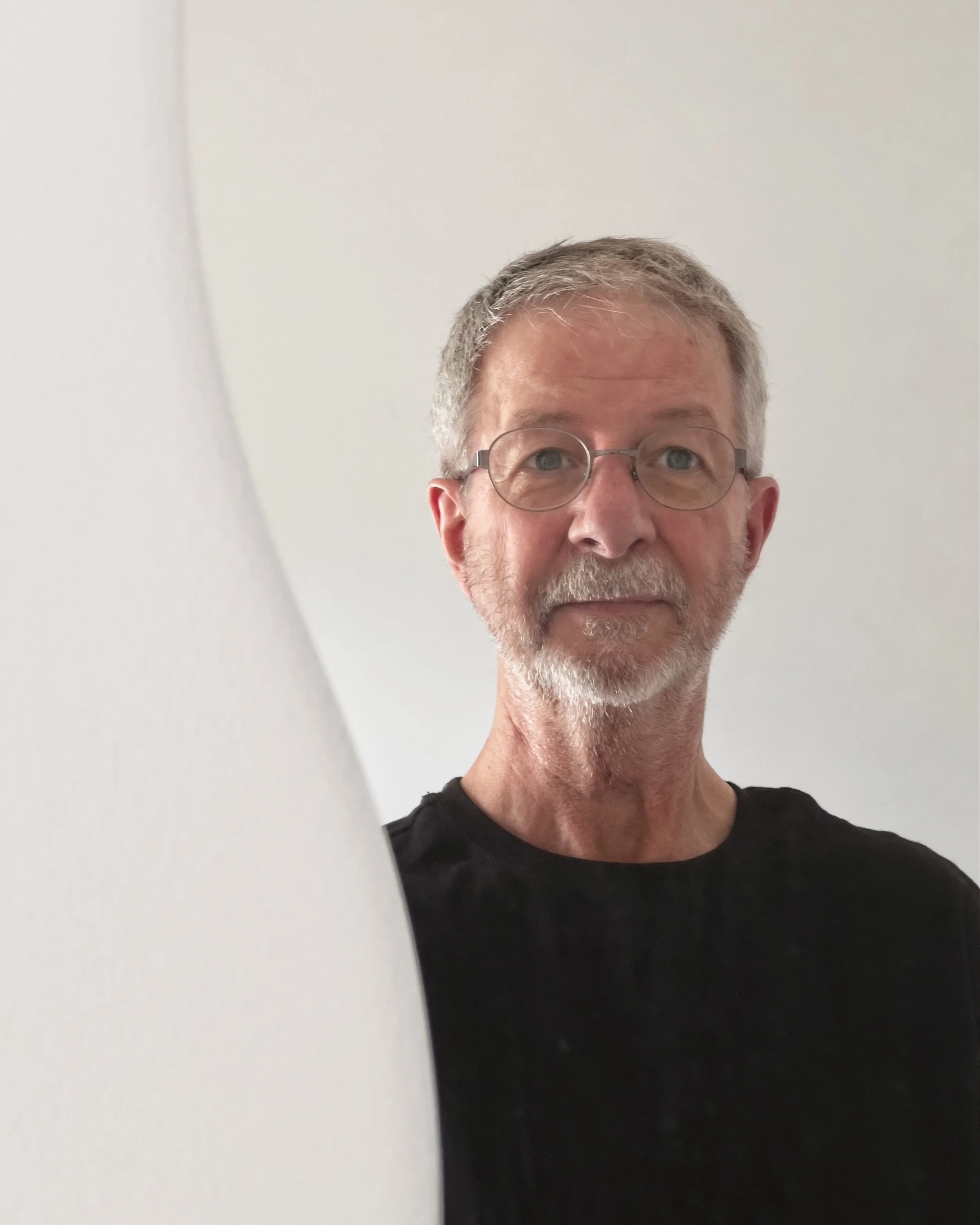
Bio
I was born in 1955 on the North Shore of the St. Lawrence River, in the province of Quebec, Canada. My early childhood was spent surrounded by wilderness and the sea, which had a profound impact on my identity as an artist. Over the years, beginning in 1977, I worked as a botanical illustrator at the Canadian Museum of Nature, Laval University, and the Canadian Ministry of Agriculture and Agri-Food. In the 2000s, I became a web designer and then a web development team supervisor.
I have always worked on my own artistic practice alongside the work I did in the service of science, but it was in 2012, when I retired from public service, that I was able to devote myself full-time to my artistic practice.
Since the eighties my artwork has been shown in over thirty group exhibitions in Canada, the United States and several European countries, in addition to three solo exhibitions and seven artist residencies. My artistic work has won international recognition and several awards, and my creations are featured in public and private collections.
Artist Statement
Two of the most impactful experiences that relate to the artwork I make happened early in my career. The first at the age of 20, where I had a moment of epiphany when, through a magazine, I discovered the world of scientific illustration. This special issue of the European magazine Graphis (published in German, English, and French) was dedicated to fields of science where illustration played an important role, and among those topics was the illustration of flora. The second event that had a major influence on my work was meeting with a fellow illustrator—a Japanese artist who used the brush-and-ink technique he had learned in Japan. I had the opportunity to watch him work on numerous occasions and mastered the technique, which I went on to use with great success.
I identify as an artist who works exclusively with drawing techniques: graphite, brush and ink, watercolor, pastel. I do not use medium like oil or acrylic, and my work is done exclusively on high quality archival paper. My creative process begins with detailed sketches, followed by a layout of the composition on the paper that will hold the final rendering. During the rendering stage, I enter a state of flow that allows me to work for very long periods of time until I reach the point where I can say to myself, “There—it’s finished!”.
I experimented with and went very far in learning digital drawing, but I have completely given up on continuing to use that medium, preferring instead to continue developing my mastery of traditional media so that one day I may reach a level of excellence that satisfies me. Now, as far as photography is concerned, it has always been a part of my life, but only as a secondary medium, and I’m using it more and more as a tool for gathering references.
When people look at the body of my work as a whole they notice at first glance the delicacy of the details. The many years I have spent studying plant structures have greatly stimulated my imagination, therefore, when people let themselves be drawn into the artwork, I’d say it’s the sense of tranquility and wonder they feel when looking at what is depicted.
In terms of how my work relate to that of other artists or art movement, I can’t help but think of the great botanical artists who have shaped this field over the centuries. Many people draw a connection between my interest in and sensitivity to nature—and the way I depict it—and the exquisite illustrations of Ernst Haeckel (1834–1919). Haeckel is certainly one of my greatest influences, but although I have drawn over a thousand plant species and am well versed in the techniques he used, I am far from feeling that I measure up to this incredible artist, scientist, and naturalist. Also, I am a Fellow Member of the Society of Botanical Artists (SBA, based in UK), and the American Society of Botanical Artists (ASBA, based in US), both societies have professional members all over the world, and I see excellence in most of its members. I fully adhere to their standards when it comes to faithfully representing plants, but I deviate from them when it comes to my imaginative work. This is the reason why it is difficult for me to identify only as botanical artist. See, for example, the series Mandalas and Fragments of an Unknown World. These are purely imaginative, and do not represent real plants. Therefore, I prefer to keep my options open and simply say that I practice drawing in general. Since also that in the coming years I will certainly broaden the scope of my practice to include other elements of nature, such as rocks and, more broadly, the environment—whether imaginary or representational, of course.
What distinguishes my personal work, developed mainly since my retirement from public service in 2012, is the way it holds two registers simultaneously: the representational and the imaginary, the scientifically observed and the poetically transformed: some of my works show us the world in a way we can all recognize; others capture the world as we have never seen it before. Both are true, often in the same drawing, and the tension between them is generative rather than contradictory. The natural form is the starting point and the anchor; the imagination is what is invited to move through it. Finally, my work is found in the intersection of natural history, drawing tradition, and contemporary art, this is a practice of unicity — one that rewards the quality of slow, sustained looking I bring to the natural world.
To continue your discovery of my artistic space, have a look at the portfolio of drawings.